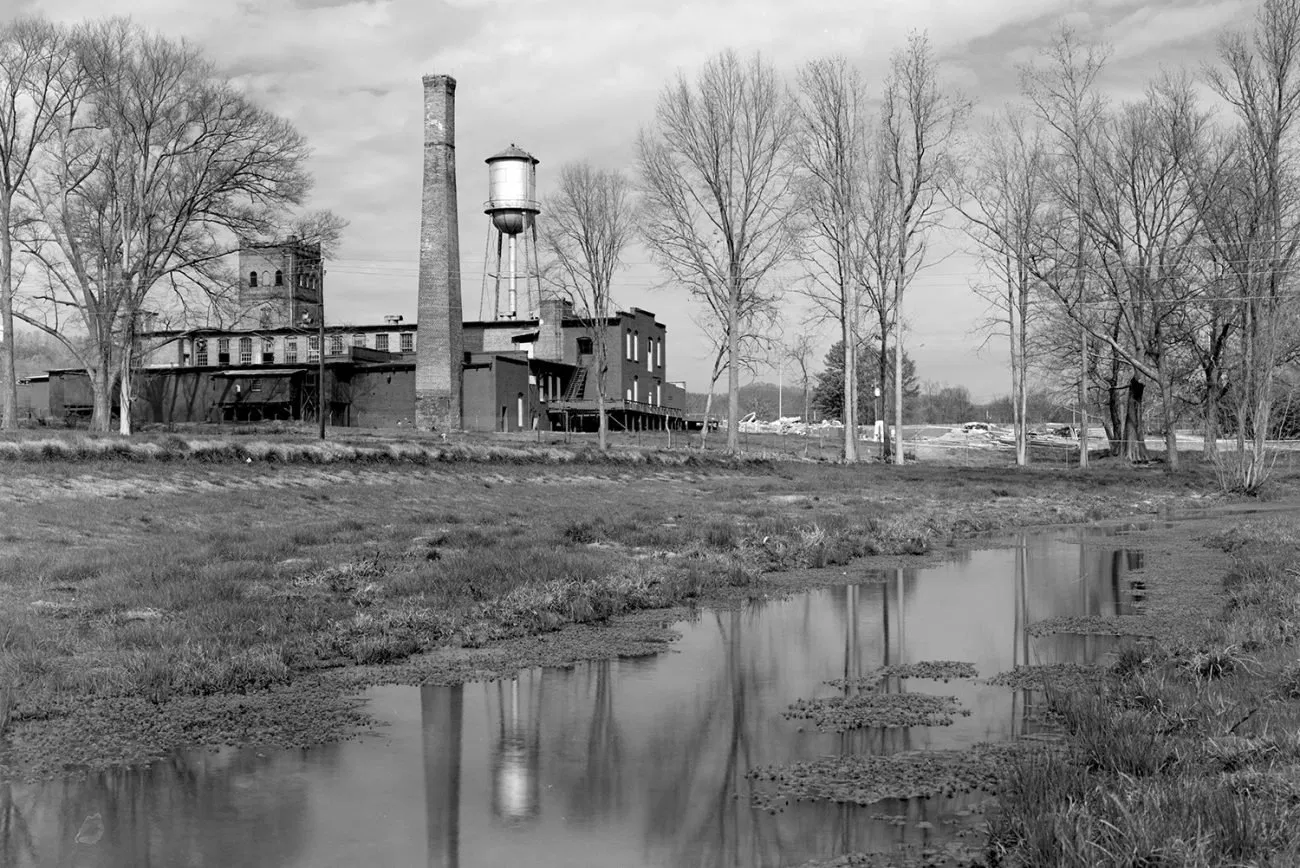
1998 photo of Blue Springs Cotton Mill
Courtesy Of Library Of Congress, click to enlarge and save.
View This Landmark In
Google Earth
The Blue Springs Cotton Mill was established in 1885 and became one of the earliest large-scale industrial operations in Oxford, Alabama. Its construction marked a shift in the town’s economy from primarily agricultural activity to textile manufacturing. The mill’s location was chosen for its access to water, its proximity to rail transportation, and its labor force drawn from Oxford and surrounding rural areas.
For decades, the mill was a major employer in the area. Many local families depended on mill wages, and employment often spanned multiple generations. Like other Southern textile mills of the period, work conditions were demanding, with long hours and production-based schedules. Women and children were employed in the mill during its early years, reflecting common labor practices of the late nineteenth and early twentieth centuries.
A mill village developed near the facility, consisting of company housing and community institutions such as churches and small stores. These neighborhoods grew closely tied to the mill’s operation, with daily life structured around work shifts and production cycles. When the mill experienced changes in output or employment, the effects were felt throughout the surrounding community.
The Blue Springs Cotton Mill remained in operation into the twentieth century but faced increasing challenges as the textile industry changed. Competition from larger manufacturers and overseas production contributed to its eventual closure, which occurred by the 1970s–1980s. After production ceased, parts of the property were reused for a short time before most of the original structures were demolished.
Today, little physical evidence of the mill remains, but its role in Oxford’s development is well documented in local records, census data, and family histories. The mill played a significant role in shaping settlement patterns, employment trends, and Oxford's growth during its formative years.